Anna May Wong had one of the greatest film entrances of all
time, as Shosho in the silent film Piccadilly. When a dirty plate upsets a patron at a London
nightclub, the owner goes on a quest to find the source of the problem. The manager of the restaurant sends him back
to the chaotic kitchens. The head chef
sends him back to the steamy scullery, where the dishes are cleaned. There he discovers a Chinese woman dancing
sensually but rather playfully on a table, for an audience consisting mostly of
tired but enthralled (white) dishwasher women. For this one moment, one can almost forget the
racism, exoticism, and sexism that permeated the world in which Wong (and Shosho) worked. Shosho’s dancing has thrown the
whole system of decadent indulgence and labor exploitation into disarray. She seems to be dancing for the sensual joy
of it, and in defiance of her precarious racial and economic status. It’s stunning, unforgettable, hypnotic.

Piccadilly was
released in 1929. According to
Wikipedia, “Gilda Gray was the top-billed actress, but Variety commented
that Wong ‘outshines the star’ and that ‘from the moment Miss Wong dances in
the kitchen's rear, she steals 'Piccadilly' from Miss Gray.’” I would go further. Wong pretty nearly renders the rest of the
cast irrelevant. The film has some
wonderful editing and cinematography, but it’s Wong’s acting that makes the film
live and breathe… and shine.
In the first part of the film Shosho looks shy and aware of her subordinate position as a poor, female, ethnic minority. Yet she never looks humiliated or
despondent. She faces off with Valentine
Wilmot, the manager of the nightclub, completely unintimidated by the stern man
who just fired her. She looks bored as
her female scullery boss talks to her on the bus, and as she later dines with
her Chinese boyfriend. Her world is
dull, narrow, confining… and she knows it.
Wilmot considers hiring her as a dancer, fretting over her and covertly sketching her in his office. Wong’s
posture is initially defiant or at least skeptical. Yet, as Shosho realizes Wilmot’s interest
(both personal and professional), her face brightens, flickering into brief
pulses of desire and ambition. It’s the
look of a woman realizing that a whole new world is possible, if she’s brave
enough to reach for it. I think there’s
more nuance and power in her eyes and lips than in the whole performances of
some modern Hollywood actors.
At a clothing shop in the Limehouse district, where she is
shopping with Wilmot, she emerges from behind a curtain with hands on hips,
glaring, as though ready for an argument or confrontation. “This is the costume I want,” say the titles,
but Wong has already said it in silence.
Wilmot concedes to her demands, despite the cost of the garment.
There’s a fair amount of exoticism and racism in
this film. BFI’s Screenonline.org.uk
also notes, “Naturally, Piccadilly's publicity made much of Wong's
exotic beauty: one contemporary poster - for the film's Austrian release -
carries an illustration of the star dancing topless. It would have been
unthinkable to portray a white actress in this way and, needless to say, no
such image appears in the film.” Yet the
film explicitly confronts racial prejudice with surprising openness. Screenonline notes how “one remarkable scene
has a white woman expelled from a bar for dancing with a black man, mirroring
the social taboo of the film's central relationship.” (http://www.screenonline.org.uk/film/id/486639/)
In Piccadilly, though, Wong always seems to transcend bias and boundaries – performing with a kind of freedom that cracks and sometimes shatters the limitations imposed on her.
In Piccadilly, though, Wong always seems to transcend bias and boundaries – performing with a kind of freedom that cracks and sometimes shatters the limitations imposed on her.
Ms. Wong would have connected personally with such issues. In the liner notes to the Milestone Collection DVD, Zhang Zhen (author of An Amorous History of the Silver Screen) remarks how Wong endured racial slurs and even physical
violence at her school in California.
She would make compromises in her film choices, doing the best she could
to form a career in a world prejudiced against her skin, her heritage, and her
gender. But she would also speak out
against such prejudice, “In a 1933 interview for Film Weekly entitled ‘I
Protest’, Wong criticized the negative stereotyping in Daughter of the
Dragon, saying, ‘Why is it that the screen Chinese is always the villain?
And so crude a villain – murderous, treacherous, a snake in the grass! We
are not like that.’” (https://en.wikipedia.org/wiki/Anna_May_Wong)
The centerpiece dance of the film – in fancy, “exotic”
costume – is spectacular. Wong sways and
floats like some shimmering cosmic particle from an alternate universe, using her
fluttering hands to great effect. Her shadow
on the floor looks like a mercurial ghost – or a glimpse of an Indonesian shadow play. The audience sits in quiet awe. Her rival dancer, Mabel, faints, knowing that
she has been eclipsed by this nuanced, hungry, dazzling performance.
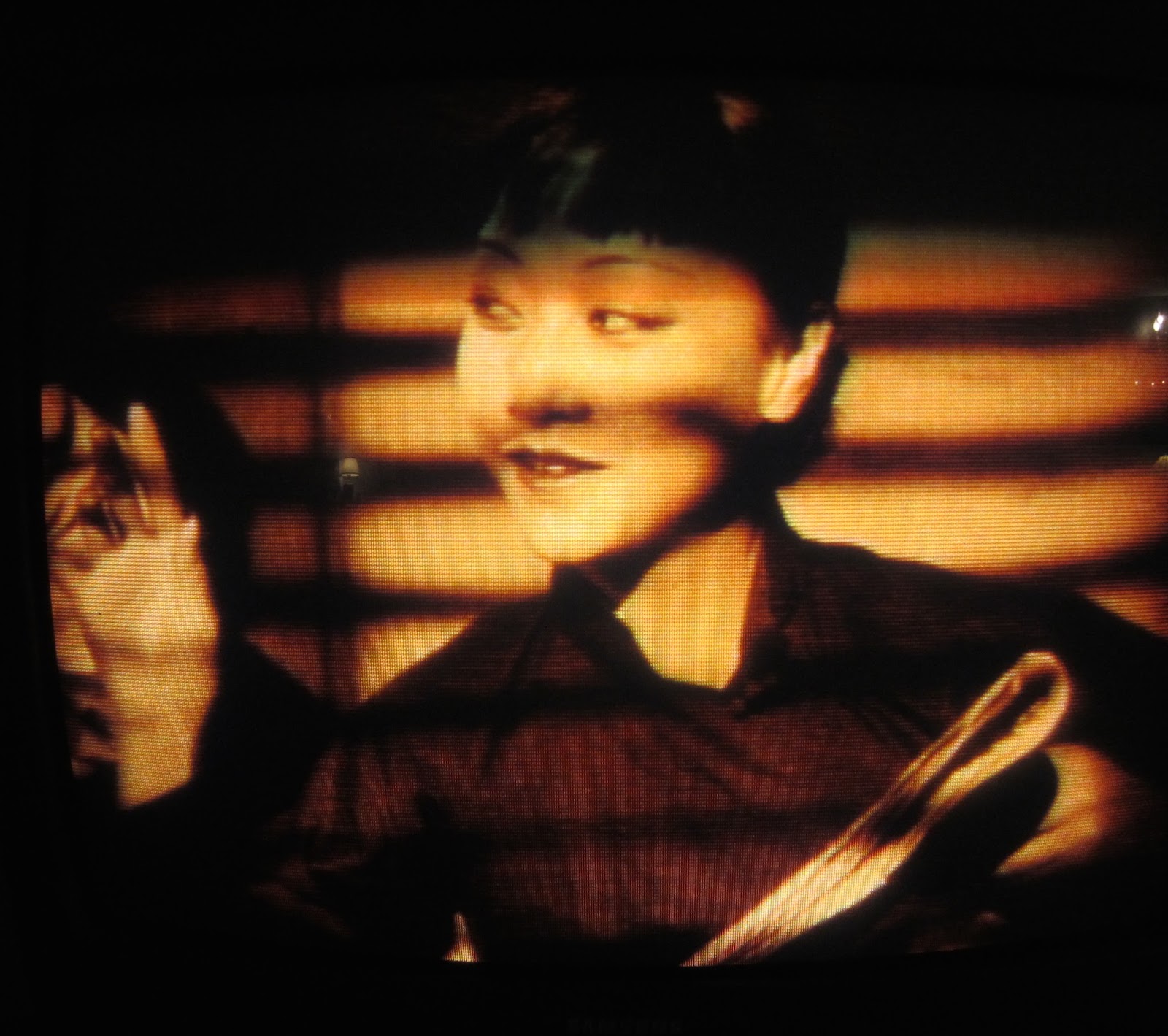
The next scene proves Wong is much more than a talented
dancer. She springs out of bed to read
glowing reviews in the paper, filled with astonishment and joy. In a virtuoso moment of silent film acting,
she reads the report to her boyfriend, tilting her head, flickering her
eyebrows, arching her hand. There are no
titles, but we don’t need them. Wong has
told us everything we need to know about dreams fulfilled, new horizons, and a
wide-open future. She playfully throws
the paper of the boyfriend’s head then (presumably) kisses him beneath it.
From this point, though, the romance with the nightclub
owner evolves. Wong now wears lavish outfits with poise and power. In a crucial scene, Shosho signs the contract to make her a star
dancer. Here Zhang Zhen draws our attention to a fascinating hidden-in-plain-sight truth. “When she signs her name on it, she writes in
Chinese, and the name appearing is not Shosho, but the actress’ Chinese name,
Wong Liu-Tsong… ‘Frosted Yellow Willow.’”
Zhang Zhen concludes, “Her signing through both her hand and body on the
screen practically made her a co-author of Piccadilly,
one of the last silent masterpieces…”
What makes the final segments of the film amazing is
that way that Wong’s character dominates the romance. It’s perfectly obvious that she’s seducing
Wilmot – not against his will, of course, but she always seems to be in control
of the situation. She takes him to a
low-class club with wild dancing. She
stares at him over her drink as he watches the masses crowding for booze. Back outside, he says goodnight, but she puts
the key to her apartment in his hand. Considering
that this is a film whose pivotal kiss was edited out by censors, her intimate encounter with him is remarkably intense. She
smiles sweetly, lies down on the couch, and seems to have a rapturous moment even
before he touches her. He tries to kiss
her hand – she touches her own lips.
After Wilmot leaves, Mabel shows up, overwhelmed with
jealousy. Wong stares her down with a series
of withering “What are you going to do about it?” glares.

When Shosho refuses a cigarette with the
excuse that she doesn’t smoke, she notices the ashtray with Wilmot’s cigarettes
and contemptuously dumps them in the trash – not even really trying to hide it. “I want him – and I shall keep him,” is one
of the titles, but, again, they almost didn’t have to bother. Her death scene has an elegant, dance-like
quality, as her hands slip away from her face.
Even after her character is killed, Wong haunts the movie like a
determined specter in flashbacks, including a tense fight scene with her jealous former boyfriend.
Ms. Wong owns this movie like few have ever owned a
movie. Sometimes she has the innocence and elegance of Audrey Hepburn and sometimes the casual confidence of Katharine
Hepburn – yet charged with a defiant sexual energy that forbids anyone to look away, or
to treat her as anything less than a being of strength and willpower. And, in this film, Ms. Wong does all this even without the power of her voice. Zhang Zhen rightly remarks that this was a
woman working in a world that didn’t deserve her.
Yes, Piccadilly is
a masterpiece of silent film – but it only achieves that because of the glorious Anna
May Wong.

